Tuesday, August 21, 2012

Safe Harbor Defense, Copyright Infringement, and Other Liabilities of the Entertainment Industry

As I mentioned in my last blog, the Entertainment Industry is run and burnt down by contracts and lawsuits.  However, this doesn't just apply to the Entertainment Industry.  Anyone starting up their own business, whether they realize or not, will have a ton of liability concerns to deal with.  Whether it be just getting your business set up or actually running it, one of the biggest mistakes a business owner can make is overlooking or ignoring liabilities.  That being said, those potentially starting a business in our world of music, film, and sports should look for liability advice specifically from your attorney.  Utilizing a great attorney will not only protect you and your business from possibly unforeseen liability issues, but will overall create a better experience for you, your employees, and your customers.  But what if you haven't gotten that far yet?  What if you are at a point where you are looking to start a business, but you'd like to gain more knowledge about the most common liability issues currently facing our industry?  Well, you're in luck.  There are a ton of resources out there that give you vast amounts of knowledge and lessons learned by others that have treaded before you, and the best part about it all is that it is almost always free.  One of the best free resources out right now in regards to the legal and liability side of the Entertainment industry is Gordon Firemark's Entertainment Law Update.  Here you can listen to multiple podcasts on various industry topics, including but not limited to current court cases, 360 deals, taxes, and more.  I took the website for a test drive to see what's what.

California Talent Agencies Act and the Safe Harbor Defense

California Talent Agencies Act and the Safe Harbor Defense


The first podcast I listened to is entitled "Episode 29- 360 deals, rights of publicity, and more".  As is the format for all of Firemark's podcasts, many topics were discussed, including music sales vs. license litigation, copyright termination, and transmission fees.  The topic that caught me immediately though was regarding 360 deals and there place in the Entertainment industry, specifically in regards to whether or not it is in violation of the California Talent Agencies Act.  For those who don't know, a 360 deal is virtually a contract that is signed by an artist with a record label that allows the record label to make money on every aspect of the artist's career.  The profits shared with the label can come not just from record sales, but from live performances, merchandising, sponsorships, acting, and more.  There are two types of 360 deals; one where the record label not only collects a profit share but owns the rights to all work, and one where the record label collects a profit share but the artist owns the rights.  The issue is with the California Talent Agencies Act.  The CTAA is a section of the California labor code that states that only a licensed agency can search for and book employment for the talent.  The act is specifically meant to protect the artist from being offered an employment opportunity that turns out to be completely different than promised.  Knowing this information, you would think that 360 deals wouldn't be possible with record labels.  Well, there's a loophole.  It's called the Safe Harbor defense.  In this circumstance, someone such as a manager or a record label executive can book employment for an artist as long as they are working in conjunction with an actual licensed representative and it is at the request of the artist.  If the Safe Harbor defense isn't applicable to whatever the circumstance may be, then there are consequences to the entity that booked the employment for the artist.  This includes repayment of all commission, along with voiding parts of, if not the entire contract that was signed.  A good example of this is the Marathon Entertainment Inc v. Blasi Supreme Court case.  The lesson learned?  Make sure you have proper representation.  Regardless of whether it's paying a lawyer to draft a contract or attempting to book a gig for a client, one missed step and you could go from making millions to owing millions.

Going "Gaga" over GaGa

Gaga Pure Platinum vs Lady Gaga Trademark Dispute


The second podcast I listened to is entitled "Episode 32- Lawyers, Libel, Logos and Lollipops".  In this podcast, one of the topics Firemark talks about is a trademark dispute that Lady GaGa is currently dealing with.  GaGa's company, At My Heart Inc, is attempting to trademark both "Lady GaGa" and "House of GaGa".  The issue is that there is a cosmetic company named Gaga Pure Platinum that has owned the trademark to Gaga since 2000, long before Lady GaGa's persona ever existed.  GaGa is attempting to register those names under the Class 3: Cosmetics & Cleaning Products trademark registration, but the USPTO has kicked back the application twice.  Because of this, Lady GaGa and her legal team have filed a federal lawsuit to attempt to gain ownership of the mark.  Now it has turned into a PR battle.  GaGa's people are claiming that they would never attack anyone's rights, but the mark they are requesting has not been used in years and every attempt they have made to contact GPP has been ignored and so they have no choice but to take the matter to court.  Gaga Pure Platinum is stating that GaGa's team is not only lying about ever attempting to contact the company, but they are attempting to bully the company into giving up a mark that GPP says is still very much in use.  I did a little of my own research and found that Gaga Pure Platinum has a functional website where you can purchase cosmetics.  With a website that's up and running and products available for sale, I don't see how GaGa and her team can make the claim that it isn't being used.  We will have to keep an eye on the news to find out what happens next.  I think the biggest lesson to learn from all this is to try and be as approachable, supportive, and open as possible when you want something from someone.  It seems to me that this whole debacle may have been easily solved without a lawsuit if GaGa's team would have followed the basic steps of communication.  Furthermore, an equally important lesson learned is to do your research on any trademarks you may want to dive into early in your career (or before you even officially start).  I'm sure GaGa will get way more of a battle now that she's as big as she is, as opposed to attempting to acquire the trademark before anyone really knew who she was.

Copyright Infringement Against Mike Tyson's Face
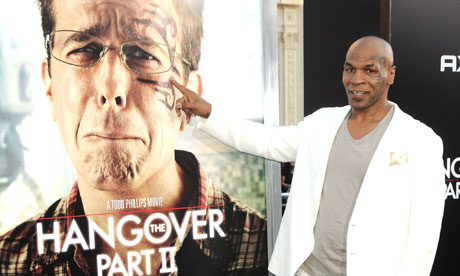
Hangover 2 Copyright Infringement Lawsuit


The third and final podcast I listened to is entitled "Episode 25- What's with all the Zombies?".  Of all of the crazy topics that are covered in this podcast, the section that caught my attention the most was the lawsuit brought against Warner Bros., the company who made "The Hangover 2".  Now, this film has already seen its share of lawsuits.  The first case, which was eventually settled out of court, involved a copyright infringement lawsuit pertaining to the tattoo on Mike Tyson's face.  The tattoo artist that worked on Mike Tyson's wearable art sued based on the claim that the tattoo was copyrighted material, and recreating it and putting it on Ed Helm's character in the movie was infringement.  Not long after, another lawsuit was brought up against Warner Bros. (this one is actually still pending) from a stunt man named Scott McLean that suffered extensive cranial damage, specifically brain injuries, while filming the movie.  He was in the middle of an automobile stunt where he was doubling for Ed Helms, and right before the shoot the stunt coordinator (and co-defendant) Russell Solberg suddenly decided to change the timing sequence and speed up the vehicle's MPH in order to increase the suspense.  When this happened, an accident occurred and McLean's head was extensively damaged.  Now Warner Bros. is being sued again on the basis that the entire premise of the film was stolen and used without consent.  Plaintiff Michael Alan Rubin claims that the script is actually a defaming rendition of a script he wrote a couple years ago, entitled "Mickey and Kirin", about his experiences in Asia during a honeymoon that went array.  The script was registered by him with the Writers Guild of America, and that is where he believes his idea was taken.  He goes on to state that that not only is he suing for copyright infringement and misappropriation of his publicity rights, but also for defamation as he claims the filmmakers "suggested the inference that he was under the influence of drugs when he ditched his girlfriend and proposed to a male-to-female transexual prostitute".  Although most of the industry believes this lawsuit provides nothing but a good laugh, Rubin believes in his accusation so much that he has decided to represent himself instead of "lawyering up".  Good luck with that, buddy.  As humorous as this may be, the biggest thing to take away from this is to have a great attorney on your side.  It definitely can't hurt.  As the evidence shows, you never know where a lawsuit may come from.  Having an experienced, meticulous attorney on your side will help prevent most, if not all liabilities from occurring.  The brick wall defense that your attorney can build will offer much greater protection than the house of cards most of us would create by attempting to prepare, prevent, and defend business liabilities on our own.

Wednesday, August 1, 2012

Lessons Learned (Or Not) in the Entertainment Industry

The legal system is seemingly forever entwined with the Entertainment Industry.  In a world that is ran and burnt down by contracts and lawsuits, the Film, Music, and Sports industries will always have a great need for legal professionals and their services.  With so many different aspects of the law, legal precedence is a vital tool that every business needs to use in order to protect them from liability.  Many artists and businesses could actually save a little money on lawyer fees if they would just do a little research about past judicial cases on their own time.  That being said, lets take a look a couple recent cases involving my particular area of focus, Artist Management.


The first case is the most recent, and involves one of the most high profile hip-hop stars out right now.  The story allegedly goes that sometime in ‘07 or ‘08 Jas Prince, son of J Prince, discovered Drake and introduced him to Cortez Bryant and Lil Wayne. Prince and Bryant came to an oral agreement at that time that Prince and his father would get paid to develop and sell Drake’s entertainment services, as well has handle the business side of Lil Wayne’s records.  In 2009 Prince decided that he wanted out, and came to a settlement with Bryant that he would receive a portion of Aspire’s profits, a majority share of interest in Drake’s masters, and a percentage of Drake’s gross income coming from the management deal.  Prince is suing because he hasn’t yet received any payments, and every time he attempts to get paid Bryant and the management team redirects him to their lawyer who won’t return his phone calls.  He states there has been a breach of the oral agreement, the settlement, good faith and fair dealing agreement…virtually every agreement they ever came to.  As if this weren’t enough, Drake is also suing because he wants to renegotiate his record contract.  And, of course, both of them want their money owed.  In my opinion, this seems like just another situation where an up-and-coming artist and their friend/manager are approached with a deal that puts sparkles in their eyes and they quickly sign, only later to realize that the deal wasn’t all that great.  Personally, I don’t understand why those just trying to break into the entertainment world don’t look at this more closely.  It’s obvious to me; don’t agree to any contract on the spot without some time to analyze, reflect, and research.  There's nothing wrong with asking for time to review a contract.  If the people you are dealing with don't want to give you the time then you probably don't want to be in business with them anyway.  Now, if the contract doesn’t have specific instructions on when, where, and how much Prince and Drake should receive compensation, then this falls on Prince and Drake.  It’s unbelievable how fiscally irresponsible some people are with their careers, and it looks like this could be another case.  Even if the stipulations are in the contract and Bryant and the company still aren’t paying, it’s again on Prince that he waited so long to confront the issue the way that he has.   The moral of the story here is to attack a problem as soon as it arises, and be as absolutely detailed as possible in your contracts.


Another interesting case that’s been in the news currently is the disagreement between Ed Kowalczyk and Action Front Unlimited, the company started by Ed’s old band Live.  The band has split, but they all still own equal share in the company.  The problem lies in the fact that the company owns the trademark rights to “Live”, and Kowalczyk has been operating his artistic business using the Live name without consent from the other members of the band.  The band’s company wants compensated for trademark infringement and dilution and false designation of origin, totaling $2 million in damages.  Kowalczyk stance is that he owns part of the company that owns the trademark so he should be able to use it accordingly.  It seems like Kowalczyk may not have the upper hand in this situation.  The other three members of the company are stating that Ed virtually refuses to recognize that he is no longer associated with the band “Live” and continues to use the trademark anyway.  It sounds like Ed might be trying to hold onto the glory days in an attempt to boost his commercial appeal.  At the same time, he is and will forever be the face of that amazing 90’s alternative band, which could potentially hold significant weight in court.  Considering this could cost Kowalczyk a good amount of money, the lesson learned here is to make sure what you’re using is in fact OK to use.  This is a responsibility that an Artist Manager needs to make sure his client is holding to.


The last case that has been in the news lately that I would like to discuss is; well, it’s believable but leaves me even more skeptical for the future of this Earth.  Here’s the situation.  Legendary front man Ozzy Osbourne is performing at his annual Ozzfest show in Phoenix, Arizona…in the middle of the day…in August.  Lets keep in mind that the average high temperature in August in Phoenix is 104 degrees.  OK, now that you have a good understanding of the environment, back to the action.  Ozzy is up on stage rocking away as only Ozzy can, when he notices a woman in the crowd with a one-year-old kid.  Yes, you read that correctly.  This brilliant woman didn’t just bring her infant to a concert; she brought the baby to a heavy metal festival in the dead heat of summer in the hottest city in the United States of America and stood close to a stage that’s pumping insanely loud and violent sound waves through speakers that are bigger than the car she probably drove in with the baby in the front seat facing the window.  I digress.  Ozzy sees this woman holding her baby, and understanding the intense heat and the stress it must be to the child, grabs a water bottle and tosses it in the lady’s direction.  Somehow the water bottle miscues and hits the baby.  Several years later, this lady now is suing Ozzy for $80,000 in damages.  Are you kidding me, lady?!?  A guy whom you obviously have great appreciation for shows compassion towards you and your family, an accident occurs, and your sorry self has to sue?  Between this story and the recent Justin Bieber lawsuit with the girl suing him for putting his arm around her during a photo, I can understand a little more why some stars are rude or introverted in public.  Both guys were being generous and compassionate to their fans, and it ends up costing them time and money.  I will never fully understand why people do and say the things they do, but I honestly do find it truly disappointing that so many people throw away their morals just to make a buck.  As far as what to take away, this case shows that anyone high profile should be analytical and cautious when interacting with fans.  An Artist Manager would need to discuss this with his clients as they gain popularity and are forced into more social interactions.


At the end of the day, we can't all act like Peter Grant.  The grand point to take away is that just by paying attention to what’s going on within your specific niche in the industry, you can be better prepared to handle any liability that could come your way.  It all comes down to analysis, detail, and preparation.  If an Artist Manager can master those three skills, they will be better prepared to take on the Entertainment World, particularly the area of Law.

Thursday, July 19, 2012

SXSW


It's a little difficult to see, but this was my seat for the SXSW (South by Southwest) presentation earlier this week.  They discussed the internship and volunteer programs, as well as some basic information about what the festival entails.  Go here to find more information.

Tuesday, July 10, 2012

Respect Your Elders...


The music industry has grown tremendously with the continual expansion of the Internet and technology in general.  There are way more budding artists putting material out than ever before, and the development of social media sites like YouTube and Facebook will just continue to push the growth.  With many more artists attempting to make it in the industry, more artist managers are needed to help develop those talents.  I mean, sure, an artist can take care of many management duties on his own when he or she is first starting out.  Eventually, however, they will need help.  The same goes for managers themselves.  It is easier to communicate with people today than it ever has been, and many resources are more easily accessible now due to technology than they have been in the past.  On the other hand, nothing beats networking and experience, and those things you can’t go buy at a store or look up on the Internet.  So, just like the artists, eventually managers need help.  That being said, where can artists and managers alike find help?  Steve Rennie, manager of the very successful rock band Incubus, has come up with his own solution.

Rennie has created a website called Renman Music & Business.  This website can be used “to collaborate, get insider access, and mentoring from the music industry veteran.”  Rennie, like most seasoned managers, often gets contacted for networking opportunities and advice from various up and coming musicians and budding talent managers.  After awhile, Rennie decided that he wanted to create a forum in which he could share exclusive content and insider tips and tricks that was low maintenance and could reach a broad audience.  He found what he was looking for with his website.  RM&B allows Rennie to communicate with his peers through online chats, community forums, and video blogs to share his advice.  With Rennie’s 30 years of experience within the industry, it’s quite silly to not use his website as a major development tool if you are trying to make it as either an artist or an artist manager.  That’s not all, though.  What’s the best part about the deal?  It doesn’t cost you a dime.

Here's an interview done with Steve Rennie, where he discusses his new venture among other things:


Wednesday, May 16, 2012

The Invaluable Asset


What is the key to creating a business and making it successful?  Driving sales?  Finding inventive ways to create more return on your profits?  What about developing and maintaining a great marketing campaign?  How about building a strong brand name and story?  I mean, sure; all of these are important components to your business.  However, I have seen a declining trend over the past few years (especially recently) of one of, if not THE most important keys to the puzzle of building a sustainable company.  It’s something that you can’t purchase, even though it’s the most valuable asset a company can have.  That asset is integrity.  It cannot be bought or sold, but it can make or break an establishment.  Some companies are built on the integrity of their product.  Some businesses pride themselves on the integrity of their customer service.  Whatever the case may be, the alarming trend is the fact that many people within today’s businesses are sacrificing their integrity to make a quick buck, advance their career or company, or fulfill a desire.  It’s truly unfortunate, especially considering often times they are running a company in which we all have interacted with or at least heard of.  Take a look at former Yahoo CEO Scott Thompson, who lied on a resume about a degree he said he earned but didn’t.  There’s also Brian Dunn and Richard Schultz, former CEOs of Best Buy.  Dunn was caught having an inappropriate relationship with an employee and it subsequently led to his resignation.  Just today, Schultz resigned after it was discovered that he knew about the misconduct and failed to report it to the board members of the company.

To be frank, I just don’t understand.  I was brought up to know that a person is only as good as their word.  My parents, teachers, and employers all talk about the importance of having good morals, values, and ethics.  How do we teach this to the next generation when they turn on the TV and see stories like this?  It’s unfortunate to say the least.  So what can we do?  As those in my generation grow into the CEO positions and we become the leaders, what can we do to make sure that we don’t sacrifice the ideals in which we were raised on just to get ahead?  The true answer is YOU.  Only you can make the internal decision to do what’s right, for better or worse.  Everyone has that reminder they can think of in times where you may be tempted to steer away from what you believe in.  Maybe it’s a photo of someone special, a promise you made to yourself, or your grandma’s look if she would see what you were about to do.  Whatever your “thing” is, find it.  Remember it.  Use it.  In a world where temptation is put in front of you every day and our beliefs are put to the test, it’s important to try to live each day being the person you want those special to you to see.  I hope our future leaders of commerce can look upon the bad decisions of our current CEOs and learn from the history instead of repeating it.

Thursday, May 3, 2012

Finding Funding for your Startup


Finding funding for a business venture is one of the most difficult things you will face as an entrepreneur.  Next to finding customers that are willing to pay for your product or service, accumulating enough capital to get your business off the ground is probably the biggest obstacle when building a viable business.  Obtaining financing as a business owner can be difficult today.  Although we are seeing some growth in the economy, banks and angel investors are still being much more cautious when it comes to taking chances on startups.  Additionally, credit scores have been damaged virtually across the board looking back on the last 10 years.  With one of the two circumstances affecting many budding entrepreneurs, looking for alternative funding is a must if you want to continue to chase your dream.

There are several forms of alternative funding that you can use to achieve startup capital for your company.  One alternative to standard bank loans are SBA loans.  SBA loans are used in most cases when all other forms of alternative funding are not available to the business owner due to certain circumstances.  The SBA backed loan tells the bank that is actually loaning the money that the government will cover a portion of the loan in the event that borrower defaults.  There are obviously additional regulations when utilizing an SBA loan, so regular funding from a bank is better if it can be achieved.  Otherwise, an SBA loan makes it less risky for the bank to take the chance and give you the money you need.

Invoice factoring is another form of funding for a startup business.  This is a good way to get money quickly for some businesses.  Once you have identified a business to work with and come to an agreed upon loan amount and conditions, you hand your accounts to the factor company.  The factor company will control all of the agreed invoices processing, take their share of their monthly payment, and send the rest to you.  This process continues until the loan has been paid off.  Once that happens, all accounts transfer back to your company.  The primary disadvantage of this is the control that is given to the factor company during the loan duration.  This risk is often times overlooked though, as there are many advantages for cash poor companies in need of funding.

When selling a tangible product, your supplier may be just the person to help you with funding.  Many businesses achieve funds for their business by striking a deal with their supplier.  The company in need of cash will receive a loan at a fair rate in exchange for a guarantee of business.  A “you scratch my back, I scratch yours” scenario, supplier financing can also offer additional benefits, such as the ability to utilize consignment shipping.  Companies often times ask for this clause in the contract with the supplier.  Doing so can save your company’s need for storage space and help in controlling overstocked items.  The biggest disadvantage is that you are now locked into that one supplier, regardless of how the business is working.  If the company were to outgrow the supply, things can be tricky for both parties on how to get out of the agreement or settle on new payment terms.

Probably the most hip, innovative way of capital funding is through the use of crowdfunding.  Many websites, such as Kickstarter and Crowdfunder, connect entrepreneurs with business opportunities with people who have the money to donate to their cause.  In return, the businesses receiving the funds have to give perks and/or rewards to those who put in money.  The biggest advantage of this is that you don’t have to pay the money back.  Additionally, funding can be easier for some as more people invest in smaller amounts.  The biggest disadvantage to this is the risk that your pitch doesn’t work.  If you set your goal at $10,000 for your venture and you only meet a $9,000 balance, all of the money is pushed back to those that donated and you leave with nothing.  This type of funding seems to be most popular with musicians and tech projects.

To bring everything together, the point I’m trying to make is to not get discouraged.  As I said before, almost every business owner at start struggles to get the money they need to get their company off the ground.  The good news is that there aren’t just one or two outlets to obtain funding.  If you work hard, do your research, plan correctly and understand your goals, getting the money you need to launch your business is just down the rabbit hole.  You just need to take the plunge.

Friday, April 20, 2012

Opinion: Jantsch's Foolproof Business Plan


When it comes to entrepreneurship, there are many reasons why a start up business may fail.  It could be a lack of knowledge of the field or not enough planning prior to launch.  The owner may become quickly overwhelmed by the responsibility of running a company and the stress can overtake the possibility of success.  Some businesses get past the first troubles of starting a new company, but quickly get consumed by the competition.  In the world of the Entertainment industry and regarding talent management specifically, the biggest obstacle is maintaining lucrative clients.  The business that is show business is one of the most, if not the most competitive industry to gain employment and be successful in.  You can be managing the most talented up and coming band in the industry and still not be guaranteed an easy road to find good paying work for your artist.  Although networking, knowledge, and being open to multiple avenues of income for your client can help; a deep focus is necessary to maintain a profitable company.  John Jantsch addresses this deeper focus.

In the blog How to Build a Business That Cannot Fail, Jantsch is precise and specific in three major focuses that can help keep your start up business out of the gutter.  The first topic Jantsch discusses is probably the one that businesses miss out most, which is the concentration between your customer focus and your business focus.  Often times a business idea is built on the notion of building a profit through selling a product or service.  Although this is important, Jantsch makes the point that in order to sell those products or services you need to maintain a client base or you won’t have anyone buying what you’re selling.  Considering the consumer is necessary in order for your idea to launch and maintain success, why not build your business on the customer experience instead of the product experience?  He makes a great point.  It can be to your advantage to work this way if you have the proper people skills.  Everyone wants to make money and everyone enjoys spending money.  Instead of building a product and searching for the customer, identify your customer first and find out what product they are looking to buy.  Bam!  Identifying the appropriate market you want to work in and doing the proper research to discover what is missing in that market that you could bring to those clients will most certainly give your business a greater opportunity for success.  That is not to say that every business decision made should be done strictly by looking at the opinion of your cliental.  The point Jantsch is making is that too many companies lose sight of their customers.  The notion to stop listening to your customers will only lead to the eventual demise of your business.  They are your greatest assets next to your team.

The second idea is to test and evolve your product.  Don’t be set in stone on what you’re selling and critique yourself against your competition as much as possible.  It’s vital for a beginning company to compare what they are selling against the competition.  Doing so is like receiving free customer feedback without spending a dime on your own product.  Being able to see what attracts people to your competitor’s product, what they do and don’t like about it, and even things such as brand strategy and pricing can all be researched and analyzed with real-time data if you study your current competition’s strategies.  This is often times missed by entrepreneurs.  A person dedicates their blood, sweat, and tears for years to develop the perfect product and often times becomes so infatuated that they refuse change.  History has shown us that this business model doesn’t work.  Henry Ford is a great example of this.  He was so in love with his original Model-T that he refused innovation and change amongst his designers, up to the point that he fired some of his most promising employees.  This almost cost Ford his company, but luckily he woke up just in time.  Don’t make this same mistake with your business.  Showing humility and absorbing feedback instead of deflecting it will serve your business much better both in the short and long term vision of your company.

The last idea is by most accounts the most difficult to achieve because of the time and effort it takes to develop.  Having a strong sales action process is vastly important if you want to offer a consumer something to purchase.  Customers aren’t just buying a product anymore; they are buying an experience.  To be honest, actually, that is going to sell your company more than the product or service you offer will.  It’s 2012; every market is saturated in some way.  The best way to differentiate yourself from your competition is by the way you handle your day-to-day business.  A strong sales process brings your clients back to shop with you again because they cannot receive the same experience elsewhere.  Once you have that sales process down, your customers becoming your marketing.  Word of mouth can be a very powerful marketing tool, and first hand accounts of great experiences won’t stay unnoticed. 

When it’s all said and done, the primary point to keep a business from failing is this: customer, customer, customer.  We live in a world where most big businesses have lost track of the client experience and the consumers are starting to fight back.  Companies like Circuit City and Blockbuster have gone belly up because they lose focus of their customer’s needs and wants and don’t evolve their services to meet the growing expectations.  Following Jantsch’s suggestions to keep a strong business model can only help in your strategy to maintain a successful company.  Really, at the end of the day, the Darwin Theory of Evolution is the perfect example of what running a business is all about; adapt or die.